Why Your Meeting Notes Are Solving the Wrong Problem
Every meeting ends the same way. Someone scrambles to compile a wall of bullet points, action items get buried beneath pages of context, and by Friday, nobody can remember what was actually decided. Sound familiar?
Here is the uncomfortable truth: most professionals are treating their meeting notes as a record-keeping exercise when they should be treating them as a strategic tool. The problem is not that your team is lazy or disorganized. The problem is that the entire framework behind how we capture and use noted notes has been built around the wrong goal from the start.
In this analysis, we will break down exactly why traditional note-taking methods consistently fail teams at the moment they need clarity most. You will learn how to identify the core dysfunction hiding inside your current documentation habits, what research and workplace data reveal about information retention after meetings, and how a smarter approach to noted notes can transform passive records into active decision-making assets. If you have ever walked out of a two-hour meeting wondering what you actually accomplished, this breakdown was written for you.
The Notes Problem Is Not What You Think It Is
Most conversations about meeting notes start in the wrong place. They focus on the quality of the documentation produced after a meeting ends, treating better note-taking as the solution to a productivity problem that actually begins hours, sometimes days, earlier. The data tells a more uncomfortable story.
Consider the baseline reality: 47% of action items discussed in meetings are never captured in writing, and 63% of workers cannot recall all tasks assigned to them earlier that same day. These figures are striking, but they describe a symptom rather than the root cause. Even organizations with rigorous documentation practices lose alignment because the act of writing something down cannot compensate for a meeting where participants were mentally absent from the opening minute.
The scale of the problem compounds this dynamic. Professionals now spend an average of 21.5 hours per week in meetings, a figure that represents a 252% increase since 2020. No manual note-taking system was designed to absorb that volume of information reliably. Human working memory has a fixed capacity, and when meetings occupy more than half of a professional's cognitive bandwidth, the quality of both participation and documentation degrades in parallel. Learning how to take meeting notes that drive action matters far less when the conditions for meaningful engagement no longer exist.
The engagement data reinforces this point. 71% of meetings are considered unproductive by the people sitting in them, and 92% of attendees admit to multitasking during calls. That level of disengagement does not emerge from poor note-taking habits. It reflects a population of professionals who arrived at the meeting without sufficient context to find it relevant, and so they redirected their attention accordingly.
This reframes the problem entirely. The conventional model treats noted notes and meeting summaries as post-meeting artifacts, outputs to be refined and distributed after the fact. But 146 hours per year, per professional, are lost reconstructing meeting context without AI assistance. That is not a documentation gap. It is a preparation gap, one that begins the moment a calendar invite lands without the background materials needed to engage meaningfully from minute one. Tools like Slack's guidance on effective meeting notes address output quality, yet the productivity loss has already occurred before anyone types a single word. Solving for notes alone leaves the larger structural problem untouched.
AI Meeting Tools Are Reactive by Design
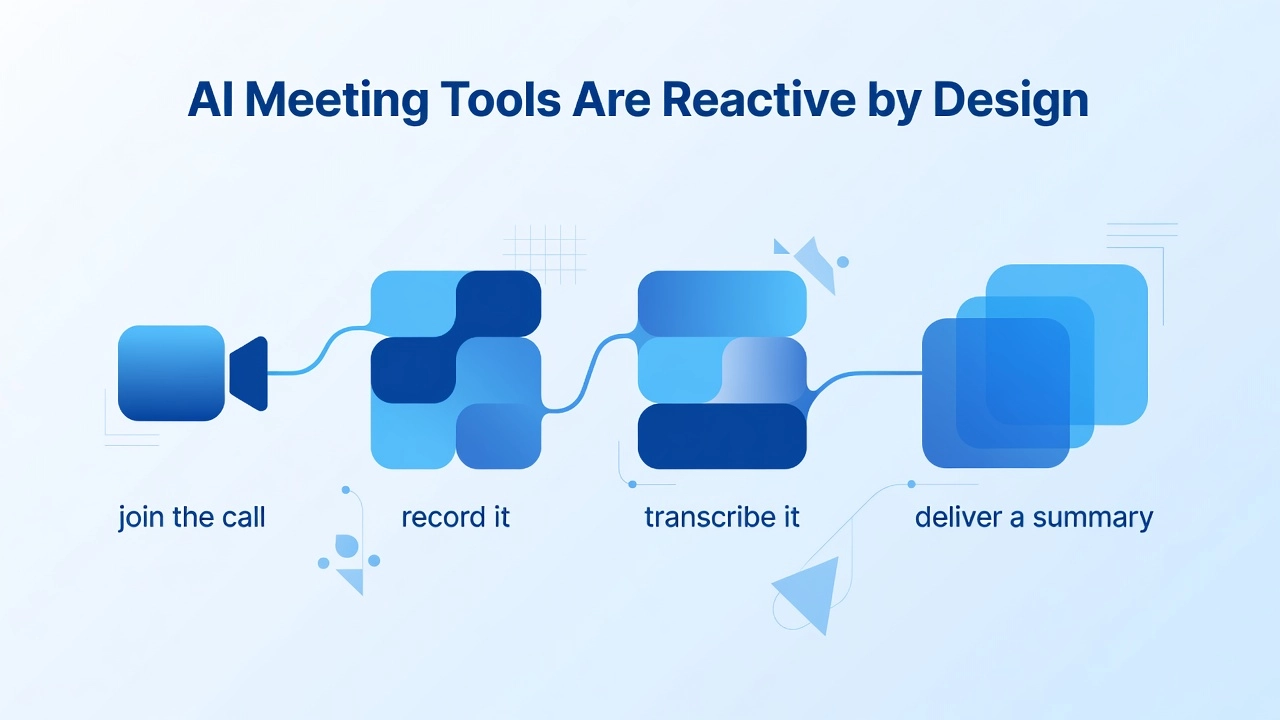
The architecture underlying every major AI meeting tool on the market today follows a single, unvarying pattern: join the call, record it, transcribe it, and deliver a summary after the conversation ends. This is not a feature gap or a version limitation. It is a deliberate design philosophy shared across the entire category, from the most basic transcription utilities to the most sophisticated workflow automation platforms.
Comparing Otter.ai, Fireflies.ai, and Fathom reveals that despite meaningful differences in interface and downstream automation, every tool in the category converts the same raw material: a conversation that has already happened. Fathom delivers polished summaries within roughly 30 seconds of a call ending, which is genuinely impressive execution. Fireflies.ai pushes further, automating CRM updates, task filing into project management tools, and structured action item distribution the moment a meeting closes. Tana converts transcripts into connected, graph-based workflows that surface relationships between ideas and decisions across meetings. Notion AI deposits structured notes directly into team knowledge bases. Each of these represents real engineering progress. Yet every single one of these workflows begins after the meeting has concluded, which means every one of them begins after the opportunity for informed, focused participation has already passed.
The Productivity Paradox Nobody Is Addressing
The market data exposes a contradiction that deserves serious analytical attention. 75% of professionals now use an AI note-taker at work, roughly double the adoption rate from 2023, and 62% report saving four or more hours per week as a direct result. Those are substantial efficiency gains on paper. Yet London School of Economics research finds that 35% of business meetings remain structurally unproductive, and 71% of attendees broadly describe their meetings as a poor use of time. Adoption is accelerating while meeting quality remains largely stagnant. The logical conclusion is that the constraint being solved by post-meeting summaries is administrative overhead, not meeting performance itself.
The behavioral data reinforces this. An estimated 67% of workers spend time during meetings actively preparing for other meetings. This statistic is damning in what it reveals: professionals are so chronically under-prepared that they are multitasking across meetings simultaneously, using one meeting as study hall for the next. Faster summaries delivered after the fact do not address this condition. By the time a summary arrives, the meeting it describes is already over, and the participant who could have contributed meaningfully did not.
The Blind Spot the Category Has Not Acknowledged
The competitive blind spot shared by every current AI meeting tool is the pre-meeting phase. None of the platforms reviewed invest meaningfully in delivering personalized, role-specific context to participants before a meeting begins. The difference this would make is not marginal. A participant who arrives already briefed on the relevant background, the stakeholder positions, and the specific decisions on the table does not just take better notes afterward. That participant asks sharper questions, challenges assumptions earlier, and moves the group toward resolution faster. Post-meeting summaries document what happened; pre-meeting intelligence shapes what happens. The entire category has optimized for documentation and left the higher-leverage intervention entirely untouched.
The Preparation Gap: What Unpreparedness Actually Costs
The financial scale of meeting dysfunction in the United States is difficult to overstate. Ineffective meetings cost U.S. businesses approximately $399 billion annually in lost productivity, a figure that places the entire AI note-taking market, projected at $740 million or more in 2026, in sharp perspective. The market built to solve the meeting problem is worth less than 0.2% of the damage the problem causes each year. That arithmetic alone signals something fundamental: the tools being deployed are not yet operating at the scale of the crisis they are meant to address.
The scale of the problem compounds because meeting time does not exist in isolation. When 57% of the average employee's workday is consumed by meetings, email, and communication overhead rather than focused, productive work, every unproductive meeting carries a multiplier effect. Each hour lost to an underprepared conversation is an hour taken from an already constrained pool of deep-work time. According to research on the hidden cost of ineffective meetings, more than half of surveyed workers regularly work overtime specifically to recover tasks lost to meeting overload, meaning the cost is not just organizational but personal, affecting employee wellbeing and sustainable performance over time.
The memory dimension of this problem is equally significant, and significantly underappreciated. Even when action items are captured during a meeting, the cognitive infrastructure required to act on them reliably is frequently absent. Research indicates that 63% of workers cannot recall all tasks assigned to them from earlier in the same day. Post-meeting notes, however accurate and comprehensive, are delivered into a memory environment that is already fragmented. The documentation exists; the mental bandwidth to process and execute it often does not. This is a gap that better transcription cannot close.
The most quantifiable expression of the preparation gap is time loss. Professionals spend an estimated 146 hours per year rebuilding context they should have entered meetings already possessing, the equivalent of nearly four full work weeks consumed entirely by catchup. Research from Drexel University further underscores how meeting overload degrades cognitive performance and sustained concentration well beyond the meeting itself.
What makes this particularly striking from a market positioning standpoint is the near-total silence around the preparation narrative in existing AI meeting tools. The dominant marketing framing across the category is reactive: better notes, faster summaries, cleaner action items. The cost of arriving unprepared, and the compounding toll it extracts on attention, memory, and organizational momentum, remains an almost entirely unoccupied space in both the product landscape and the content ecosystem around it.
Why 84% of People Change Their Behavior Around AI Bots
The behavioral distortion problem is one of the most underreported failures in the AI meeting tool market. According to The State of Meeting Note-Taking 2026, 84% of meeting participants report changing their behavior or withholding information when they notice an AI bot has joined a call. The implications of that figure deserve careful examination. A transcript generated from a session where the majority of participants are self-censoring is not an accurate record of what was discussed. It is a documented version of what people were comfortable saying on the record, which is a fundamentally different thing. The tool designed to capture authentic decision-making instead produces a systematically sanitized artifact, undermining the entire premise of AI-assisted meeting documentation.
Privacy as the Market's Largest Structural Obstacle
This behavioral distortion does not exist in isolation. It sits within a broader organizational climate where 73% of businesses identify privacy as the single largest barrier to adopting AI meeting tools. That consensus becomes more consequential when set against the scale of projected market growth, with organizational adoption forecast to approach 78% by the end of 2026. The gap between adoption trajectory and organizational readiness is not a minor friction point; it is a structural contradiction that the current generation of bot-based tools has not resolved.
The enterprise adoption data makes this contradiction concrete. Small businesses are adopting AI note-taking tools at rates between 78% and 81%. Enterprises with 5,000 or more employees sit at 43%, a gap that reflects not a lack of interest but a wall of compliance requirements. SOC 2 certification reviews, data-residency mandates, model-training carve-outs, and CISO governance protocols create procurement timelines that individual-use tools were never designed to navigate. The result is that the organizations with the most complex meeting environments and the most at stake in those conversations are the least likely to have sanctioned tooling in place.
The Shadow IT Window and Its Compounding Risk
That governance gap has a measurable lifecycle. Research on AI governance oversight finds that 85% of organizations have integrated AI into core operations, yet only 25% report comprehensive visibility into how employees are actually using it. AI note-takers follow a predictable path through that visibility gap: they enter organizations as unauthorized shadow IT, individual employees inviting third-party bots into calls without IT awareness, and they are formally sanctioned approximately 18 months later, typically after CISO teams discover the breadth of adoption. During that 18-month window, proprietary pricing discussions, unreleased roadmap details, and customer personal data are routinely routed through third-party cloud infrastructure with no governance structure in place.
A Different Architecture for a Different Risk Profile
The consent and behavioral distortion problems that define bot-based tools are not universal features of AI meeting assistance. They are specific consequences of a specific architectural choice: recording live calls and uploading that audio to external systems. As analysis of the current AI meeting tool landscape notes, this "bot-plus-cloud" model represents a first-generation design constraint rather than a permanent requirement. Tools that operate on existing company documents rather than live recordings sidestep consent requirements, eliminate the behavioral distortion trigger entirely, and present a fundamentally different risk profile for enterprise procurement reviews. For organizations where CISO sign-off is a prerequisite, the structural distinction between "records your calls" and "works from documents you already control" is not a minor feature difference. It is the deciding factor.
The Decision-Ready Meeting: A Framework for What Notes Should Actually Do
A decision-ready meeting begins before anyone opens a calendar invite. The defining characteristic of a truly productive meeting is not the quality of its minutes or the accuracy of its transcript; it is whether every participant walks in with the relevant context already absorbed, so that the opening minute is spent on judgment rather than orientation. Research from Harvard Business Review confirms that 71% of senior managers consider meetings unproductive, and the orientation tax is a significant driver of that figure. When a meeting must first explain itself to its own attendees, the organization has already paid a preparation debt it will spend the rest of the session trying to clear.
The Limits of Post-Meeting AI
The action-item completion rate improvement associated with AI note-taking tools, rising from 50 to 60% without them to 85 to 95% with them, is a meaningful operational gain. It should not, however, be mistaken for an improvement in decision quality. Completion rates measure what happens after the meeting concludes, tracking whether tasks get executed and deadlines get honored. They say very little about whether the decisions made during the meeting were well-informed, timely, or even necessary. A team can execute a poor decision with perfect efficiency. The current generation of AI meeting tools has optimized the back end of the meeting lifecycle while leaving the front end entirely unaddressed.
This is not a minor omission. Per research on planning and leading effective meetings, the pre-meeting phase is structurally equivalent in importance to the meeting itself. Preparation determines the quality of participation, and the quality of participation determines the quality of outcomes. An AI tool that only activates after the meeting starts has missed the highest-leverage intervention point available.
Notes as an Input, Not Just an Output
The decision-ready framework reorients AI's role entirely. Instead of treating the meeting note as a record of what was said, it treats the note as context delivered before anyone speaks. The document, the briefing, the summary of prior decisions: these become inputs that participants absorb in advance, not artifacts they receive afterward. This distinction matters because it shifts the metric of success. The question is no longer whether action items were captured accurately; it is whether the first minute of the meeting was spent making a decision rather than explaining the agenda.
Personalization amplifies this effect considerably. A CFO entering a product review meeting needs financial exposure framing drawn from the same source documents that provide an engineer with technical dependency mapping. Identical documents, filtered through different lenses, serve entirely different cognitive needs. A single static briefing distributed to all attendees treats a diverse group as an undifferentiated audience, and the result is predictable: someone in the room is either over-briefed on irrelevant detail or under-briefed on the context that matters most to their role.
Quorum Tech addresses this gap directly. By transforming existing company documents into personalized audio briefings averaging around five minutes tailored to each individual meeting participant, it enables teams to arrive at the decision-making stage from the first minute. The orientation phase is removed not by shortening it, but by completing it before the meeting begins. For organizations spending significant collective hours each week in preparatory or catch-up conversations, that structural shift represents a compounding time return with every meeting held.
Why Audio Briefings Fit the Way Professionals Actually Work
The headline productivity numbers for AI meeting tools are real, but they conceal a significant distribution problem. Research shows that 62% of AI tool users report saving four or more hours per week, yet those savings concentrate among professionals who were already engaged with written summaries and documentation before meetings. The worker who consistently reads pre-meeting briefs, reviews slide decks, and arrives prepared was already capturing most of the available efficiency gain. The professional who lacks time to do any of that, which describes the majority of people spending 21.5 hours per week in meetings, does not benefit from better text summaries because the bottleneck was never summary quality. It was format compatibility. What this population needs is a briefing mechanism that fits into time they already have, specifically the commute, the walk between buildings, the ten-minute gap between consecutive calls, and the morning routine before a screen ever opens.
The five-minute podcast format is a structural response to that constraint, not a design preference. When meeting load consumes more than half of a professional's working week, adding a pre-reading requirement to each calendar invite introduces compliance friction that most participants will quietly abandon within two to three weeks. The format must require no dedicated cognitive workspace to consume. Audio satisfies that condition in a way that text documents, slide decks, and written briefings cannot, because audio is cognitively compatible with the light physical movement that fills the margins of a professional's day. Listening during a commute or a short walk does not compete with a focused work block; it occupies time that would otherwise be spent passively. The briefing gets done not by adding a task to the day, but by replacing dead time with productive consumption.
The technical foundation for this model is now mature enough to support enterprise deployment at scale. Leading AI transcription models now exceed 95% accuracy on clean audio, with some platforms reporting figures closer to 99% under controlled conditions. That accuracy threshold matters because voice-based content delivery depends on fidelity; a briefing that mishears names, misrepresents figures, or garbles context defeats its own purpose. At current accuracy levels, the audio output is reliable enough to substitute for the written document rather than merely approximating it.
Critically, the podcast briefing model places no new content creation burden on meeting organizers. Quorum Tech converts existing company documents, prior meeting notes, reports, and slide decks into a personalized audio narrative for each participant. The organizer does not write a new script or record new material. The content already exists; the transformation is what changes. This distinction matters for adoption: tools that require behavioral change from the person scheduling the meeting face resistance at the point of deployment, while tools that work from assets the organization already produces remove that friction entirely. The briefing is generated from the documented record of work already done, and it reaches participants in the format most likely to be consumed before the meeting actually begins.
Where the AI Notes Market Is Heading and What It Reveals
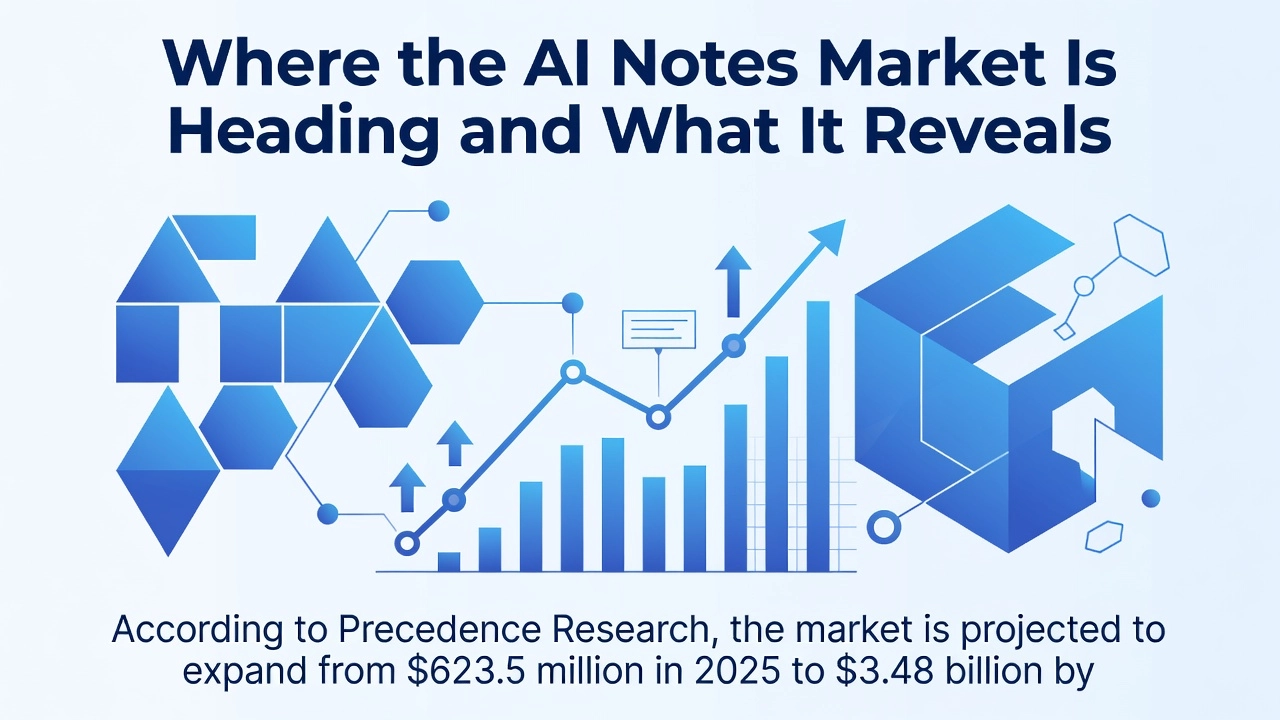
The numbers behind the AI note-taking market reveal something more significant than ordinary software growth. They expose the scale of a problem that organizations have not yet solved. According to Precedence Research, the market is projected to expand from $623.5 million in 2025 to $3.48 billion by 2035, representing an 18.75% compound annual growth rate over the decade. Technavio's parallel forecast projects an additional $821 million in incremental growth at a 21.3% CAGR through 2029, suggesting that near-term acceleration is even steeper than the long-run average implies. These are not the growth curves of a maturing utility. They are the growth curves of a category still searching for a product that fully addresses the underlying demand.
North America's Structural Dominance
North America accounts for 32% of total market growth share during the 2024 to 2029 forecast period, a concentration driven by three reinforcing factors. First, US enterprise environments generate meeting volume at a rate that is unmatched globally, with professionals now averaging 21.5 hours per week in meetings. Second, established SaaS procurement infrastructure in North American organizations compresses the evaluation-to-deployment timeline considerably, accelerating category-wide adoption. Third, and most consequentially, increasing scrutiny from CISOs around bot-based recording tools is creating compliance friction that incumbent solutions have not adequately resolved. The 84% behavioral distortion rate documented in earlier sections is now surfacing in enterprise procurement reviews as a governance liability, which is reshaping how IT leaders evaluate which tools actually belong in their meeting stack.
Two Clusters, One Missing Category
The competitive landscape has bifurcated into recognizable clusters. The first consists of summary generators and transcript-centric tools focused on producing structured outputs from recorded audio. The second consists of workflow automation connectors that route meeting content downstream into project management systems and CRM platforms, prioritizing integration depth and role-based governance over summarization quality. Both clusters perform their respective functions with increasing precision, and both are being adopted at scale. What neither cluster addresses is what happens before audio capture begins. The preparation layer, specifically the work of briefing participants on relevant context, counterparty history, and decision stakes before they enter a meeting, remains entirely unoccupied by any current market entrant.
Hardware Signals a Deeper Shift
A structural shift is also forming at the physical layer of the market. Dedicated AI recording wearables and MagSafe-style attachable capture devices are entering the market as professionals seek higher audio fidelity and more discreet capture methods than laptop microphones allow. This trend signals that the physical context of a meeting is becoming a product variable, not merely a software configuration. When hardware differentiation enters a software-defined category, it typically marks the transition from early adoption to professional-grade infrastructure. The pre-meeting preparation space, by contrast, requires no recording at all. It operates entirely on existing documents, calendar data, and organizational context, which means the tools built to occupy it face none of the compliance friction, behavioral distortion risk, or hardware dependency that currently constrain the rest of the market. That is not a minor advantage. It is the foundation of a structurally distinct and defensible strategic position.
Rethinking What Good Meeting Notes Are For
The evidence accumulated across this analysis points to a single, inconvenient conclusion: the AI meeting tools market has optimized aggressively for post-meeting documentation while the preparation gap, worth 146 hours per professional per year and a share of the $399 billion annual productivity loss, remains structurally unaddressed. Every dollar invested in transcription accuracy, summary quality, and action-item extraction operates downstream of the core failure. The problem does not begin when the call ends; it begins when participants join without sufficient context to engage at the decision-making level.
Teams that want to move from reactive note management to proactive meeting readiness should start with a direct audit of their current tooling. The diagnostic question is simple: at which point in the meeting lifecycle does each tool in your stack intervene? If every answer is "during" or "after," your organization has a preparation gap that no amount of post-call summarization will close. The decision-ready meeting framework provides a practical evaluation lens: does this product help participants arrive informed, or does it help them recover from arriving unprepared? These are not equivalent outcomes, and treating them as interchangeable is precisely how organizations continue spending 21.5 hours per week in meetings where 71% of attendees consider the time unproductive.
Quorum Tech addresses this gap directly. By transforming existing company documents into personalized audio briefings averaging around five minutes delivered before the meeting begins, it is the only current solution operating in the preparation phase. For teams carrying a full meeting load, the highest-leverage intervention is not a faster summary after the call. It is sharper context before it.