Investment Committee Meetings: Why Preparation Is Your Costliest Blind Spot
Too frequently, investment managers walk into investment committee meetings carrying meticulously crafted portfolios, sophisticated models, and decades of market experience. Yet a surprising number of those same meetings end in delayed decisions, misaligned priorities, and costly strategic drift. The culprit is rarely the quality of the investments themselves. It is the preparation, or rather the lack of it, that quietly erodes value long before a single vote is cast.
The investment committee serves as the final arbiter of capital allocation decisions, risk tolerance, and long-term portfolio strategy. When that process is undermined by poor agenda design, inadequate pre-read materials, or misaligned stakeholder expectations, even the most sophisticated investment thesis can collapse under the weight of preventable confusion.
This analysis examines the structural and behavioral blind spots that compromise investment committee effectiveness, drawing on governance best practices and decision-science research. You will walk away with a sharper understanding of where preparation failures originate, how they compound across meeting cycles, and what high-performing committees consistently do differently to protect both their time and their returns.
What an Investment Committee Actually Does
An investment committee is a formal governance body vested with fiduciary and legal accountability for reviewing, approving, and overseeing investment decisions within an organisation. This structure appears across a wide spectrum of institutional contexts, including asset managers, pension funds, endowments, private equity and venture capital firms, sovereign wealth funds, family offices, and corporate treasury functions. While the mandate and risk appetite of each entity type differs considerably, the underlying governance obligation remains consistent: decisions must be documented, defensible, and made within a defined accountability framework. Understanding this foundational role is essential before examining why preparation quality so directly determines committee effectiveness.
Composition and Role-Specific Information Needs
The typical investment committee draws together a Chief Investment Officer, portfolio managers across relevant asset classes, a risk officer, a compliance lead, and one or more external or independent advisors who provide specialist expertise and constructive challenge. What is often underappreciated is that each of these roles arrives at the table with a fundamentally different information requirement. The risk officer needs current exposure, VaR, and liquidity metrics. The compliance lead requires regulatory screening results and covenant checks. The external advisor, potentially less embedded in daily operations, needs contextual background on the deal or portfolio position under review. A CIO chairing the session needs macro context and agenda governance. This divergence in information needs is not incidental; it is structurally significant and shapes how pre-meeting materials must be prepared and distributed.
Agenda, Cadence, and Regulatory Obligations
Standard agenda items typically encompass portfolio performance review against benchmark, new investment proposals with accompanying due diligence documentation, risk reports, macroeconomic updates, and increasingly, ESG considerations including climate risk assessments and sustainable finance taxonomy compliance under frameworks such as the EU's SFDR. Each of these items carries a substantive pre-reading requirement. Meeting cadence varies considerably: institutional investors such as pension funds and endowments typically convene on monthly or quarterly fixed schedules, while PE and VC committees operate on deal-driven or ad hoc timelines, compressing preparation windows significantly.
Regulatory obligations reinforce the governance stakes of every session. In Switzerland, FINMA's corporate governance expectations require supervised institutions to maintain documented, traceable decision-making processes at committee level. Across the EU, MiFID II and AIFMD embed formal governance requirements into investment firm operations, covering product governance, suitability obligations, risk management separation, and regulatory reporting. These frameworks do not merely encourage structured preparation; in practical terms, they demand it. Every investment committee session operates within a regulatory context where the quality of deliberation and the completeness of member preparation carry direct compliance implications.
The Pre-Meeting Preparation Burden Is Getting Worse
The materials an investment committee member is expected to absorb before a single session have expanded dramatically over the past decade, and the trajectory shows no sign of reversing. A typical pre-meeting pack now encompasses investment memos running ten to thirty pages per deal, deal briefs, portfolio risk reports, macroeconomic and sector updates, liquidity summaries, compliance annexes, and minutes requiring review from the prior session. For committees operating in active deal environments, such as private equity or venture contexts, multiple concurrent opportunities may each carry their own supporting documentation. The cumulative reading burden per meeting cycle routinely runs to several hours, and that baseline figure is rising.
The ESG and SFDR Documentation Layer
Since the EU Sustainable Finance Disclosure Regulation came into force at Level 1 in March 2021, with Level 2 regulatory technical standards following in January 2023, in-scope fund managers have been required to produce and review a mandatory layer of documentation that simply did not exist prior to that inflection point. Principal Adverse Impact statements, entity-level and product-level disclosures, and periodic sustainability reports must now be reviewed alongside traditional financial and risk data at each committee cycle. SFDR mandates at least fourteen mandatory PAI indicators for Article 8 and Article 9 funds, with additional opt-in indicators extending that set further. For committees operating across ESG-integrated portfolios, this regulatory layer represents a structurally permanent addition to the pre-reading stack, one that grows in complexity as portfolio coverage broadens and as reporting standards continue to be refined by ESMA. According to Investopedia, the sophistication of modern investment analysis has expanded considerably, reflecting precisely the kind of multi-dimensional data environment committees now navigate.
The Hybrid Committee Compression Problem
Post-pandemic normalisation of hybrid and distributed working has introduced a structural coordination problem that pre-existing committee governance frameworks were not designed to handle. Committee members at global asset managers, pension funds, and family offices increasingly operate across multiple time zones, compressing the window available for synchronous preparation and real-time alignment before a meeting convenes. Where pre-reading was once reinforced through in-office proximity and informal corridor alignment, distributed teams now depend almost entirely on asynchronous tools; shared document portals, recorded briefings, and email chains that compete for attention against each member's existing workload.
The True Cost of Unprepared Attendance
The professionals who sit on investment committees are, almost without exception, among the most senior and expensive in their organisations. CIOs, CFOs, board-level trustees, and senior portfolio managers carry highly compressed schedules where discretionary time is measured in minutes rather than hours. When pre-reading demands four to eight hours per meeting cycle and competes with active deal management, regulatory obligations, and client responsibilities, some proportion of members will inevitably arrive underprepared. That reality carries a cost that extends well beyond inconvenience.
When members have not completed pre-reading, the opening phase of a meeting converts from deliberation into re-briefing. The committee chair or memo author must reconstruct context that should have been absorbed in advance, consuming the session's most cognitively fresh time on background orientation rather than strategic judgment. In a ten-person committee meeting monthly, even a conservative estimate of two hours of in-session catch-up per meeting compounds to 240 senior hours lost annually, before accounting for any opportunity cost from delayed decisions. This is the cold start problem in institutional form: the meeting begins, but the conditions for high-quality deliberation have not been established. Decision quality degrades, deliberation time shortens, and the risk of poorly-reasoned or rushed investment conclusions rises in proportion to how wide the preparation gap is across the room.
The Quantified Cost of Arriving Unprepared
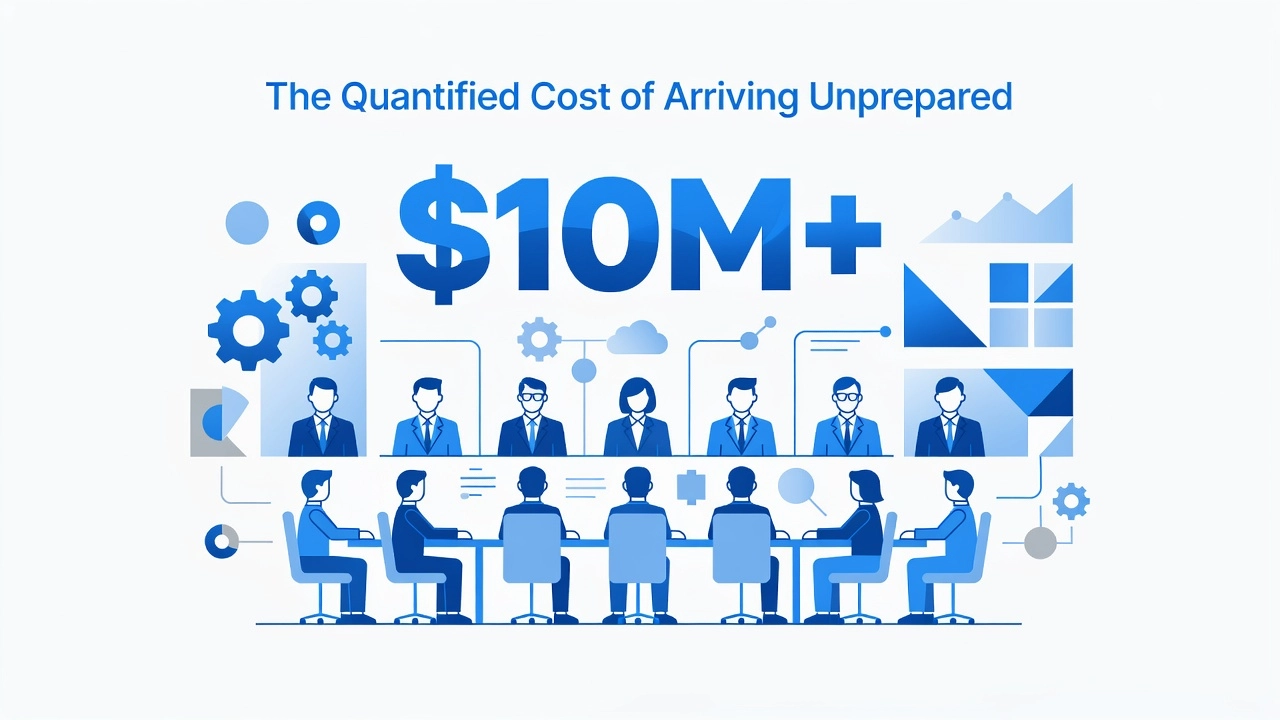
The inefficiency has a number, and it is large enough to demand attention from every CIO and governance officer responsible for committee infrastructure.
Consider a straightforward illustrative model: a mid-sized institutional investment committee of ten senior professionals meets monthly. At each session, members who arrived without full command of the pre-read materials require, on average, two hours of in-meeting orientation before substantive deliberation can begin. The arithmetic is unforgiving: 10 members × 2 hours × 12 sessions = 240 senior hours lost annually to background catch-up rather than the strategic judgment those hours were supposed to produce. This is not a theoretical scenario. It reflects the documented reality of committees operating without structured, role-specific pre-meeting preparation.
Attaching a Cost to the Hours
Hours become strategically persuasive when translated into currency. Senior investment professionals operating at VP-to-MD level, including portfolio managers, risk officers, and external advisors, carry a blended fully-loaded hourly cost (base compensation, benefits, and overhead allocation) that credibly ranges from $300 to $600 per hour in major financial centres, a range consistent with compensation benchmarks published by specialist financial services recruiters and institutional investor surveys. Applied to the 240-hour figure, this produces an annual direct labor cost of $72,000 to $144,000, attributable solely to in-meeting orientation that disciplined preparation could have eliminated. For a CIO evaluating meeting infrastructure, that figure is not a rounding error; it is a line item.
Why the Calculation Understates the True Cost
The $72,000 to $144,000 figure is, if anything, conservative to the point of being charitable. It excludes three compounding cost categories that governance officers should model separately. First, deferred decisions generate follow-up meeting cycles; every agenda item that cannot be resolved because the committee lacks a shared contextual baseline multiplies the senior time consumed before resolution is reached. Second, decisions made on incomplete information carry reversal risk; the transaction costs, rebalancing friction, and opportunity loss associated with reversing an investment decision dwarf the cost of the original meeting. Third, and most consequentially, documented evidence of uninformed or insufficiently prepared decision-making exposes fiduciaries to regulatory scrutiny under frameworks including the FCA's Senior Managers and Certification Regime and equivalent ERISA fiduciary standards, where remediation obligations and reputational damage operate on an entirely different financial scale.
Preparation as a Capital Allocation Decision
The most durable reframe available to governance professionals is conceptual rather than arithmetical: committee meeting time is a finite capital resource, and its internal allocation is a zero-sum problem. Every minute spent absorbing background context inside the meeting room is a minute not spent on strategic deliberation, independent challenge, or the exercise of fiduciary judgment. Committees exist precisely to apply senior expertise to consequential decisions. Consuming that expertise on orientation tasks is not merely inefficient; it is a misallocation of the governance capacity that regulators, trustees, and beneficiaries assume is being deployed productively. Framed this way, the question of whether committee members arrive prepared is not an administrative concern. It is a capital allocation decision with measurable consequences.
This worked example, to the best of our analysis, represents a genuine gap in the published literature. A review of existing content across major investment and financial planning resources confirms that no publicly available source models the quantified annual cost of unprepared investment committee attendance with this specificity. For CIOs benchmarking their governance infrastructure against peers, and for governance officers building the case for preparation tooling, this calculation provides original, citable analysis. The model is transparent in its assumptions, which means any committee can substitute its own size, meeting frequency, and blended hourly rate to produce a figure calibrated to its precise context. Tools like Quorum that systematically eliminate in-meeting catch-up convert this cost from a structural inevitability into an avoidable expense.
The Information Asymmetry Problem No One Names
There is a structural flaw in most investment committee meetings that almost no governance framework explicitly names, yet almost every experienced committee member has felt it. Call it preparation asymmetry: the significant gap in contextual knowledge between the member who authored or closely reviewed a deal memo and the member who skimmed the executive summary on a flight the morning of the meeting. Both individuals are seated at the same table, carrying the same formal vote, but they are not operating from the same informational position. The asymmetry is rarely acknowledged, and that silence makes it more damaging, not less.
The consequences for discussion quality are direct and well-documented in organisational psychology. Research on information dominance in group settings, including the foundational work of Sunstein and Hastie in Wiser: Getting Beyond Groupthink to Make Groups Smarter, demonstrates that better-briefed participants naturally anchor group deliberation. They frame the questions, set the terms of debate, and establish the parameters within which others respond. Critically, this dynamic operates independently of expertise or fiduciary relevance. A portfolio manager who authored the investment memo may dominate the risk discussion even where the risk officer, who skimmed the document, holds the more structurally appropriate judgment. The committee's collective intelligence is not being pooled; it is being filtered through whoever arrived best prepared.
The groupthink risk compounds this problem in ways that strike at the foundational purpose of a multi-member governance body. When less-prepared members lack the contextual grounding to challenge a proposal independently, deference becomes the default position. Irving Janis's taxonomy of groupthink, developed through studying institutional decision failures, identifies the illusion of unanimity and the self-censorship of dissenting views as central failure modes. Both emerge naturally when knowledge asymmetry is steep and time pressure is high. A committee that was constituted specifically to introduce checks, independent perspectives, and distributed fiduciary oversight effectively replicates the judgment of its best-briefed member rather than the collective judgment of the group.
The structural solution is not longer meetings or heavier pre-reading packs; both of those responses have already been tried and found insufficient. The solution is equalising the contextual baseline before the meeting begins, through personalised briefings calibrated to each member's role and existing knowledge level. A risk officer and an external advisor do not need the same preparation material. They need preparation designed for their specific vantage point, delivered in a format that respects the time constraints of senior professionals.
This is precisely where tools like Quorum create measurable governance value. By automatically transforming existing company documents into personalised, role-specific briefings for each committee member, Quorum ensures that the CIO, the compliance lead, and the independent advisor each arrive with the contextual depth their function requires. Genuine deliberation becomes possible because it starts from a shared foundation rather than a patchwork of partial reads. The downstream outcomes are not theoretical: committees operating from an equalised informational baseline produce decisions with fewer reversals, reduced deference-driven consensus, and tighter alignment with the organisation's stated investment mandate and risk parameters. In governance terms, that is not an operational improvement. It is a structural one.
When Minutes Matter: Investment Committees Under Pressure
Not all investment committee sessions arrive with adequate notice. While the previous sections have addressed the chronic preparation burden of scheduled meetings, a categorically different challenge arises when a committee must convene urgently, with little or no preparation window. Breaches of investment mandate, erroneous trade execution, counterparty default events, and sudden liquidity dislocations each carry the potential to trigger an unscheduled or accelerated session where members are expected to deliberate at the same standard as a fully prepared quarterly review, but within a fraction of the time.
The Anatomy of a Crisis Session
These four emergency triggers share a critical structural feature: they demand committee-level authority and governance documentation at precisely the moment when the normal preparation cycle is unavailable. A mandate breach, for instance, occurs when a portfolio holding, concentration limit, duration constraint, or asset class boundary is violated, whether through active error, portfolio drift, or operational failure. The committee must simultaneously assess the scope of the breach, determine a remediation strategy, and produce a governance record demonstrating that it identified the violation, deliberated appropriately, and acted with procedural prudence. Regulators reviewing committee minutes following a mandate breach are not merely assessing whether the right decision was made; they are assessing whether the process met the required governance standard. An underprepared member whose questions reveal factual confusion about the breach parameters does not simply slow the meeting. That confusion becomes part of the record.
When a Live Position Is Moving Against You
The erroneous trading scenario presents an even sharper version of this pressure. When a trade is executed outside authorised parameters, whether wrong instrument, wrong size, wrong direction, or beyond a delegated authority threshold, the committee must understand the current risk profile of the position, not the profile at execution. Market conditions are moving in real time. Remediation options, including immediate reversal, hedging, or structured unwind, each carry different P&L and market impact implications that change with every passing minute. A counterparty's acceptance window for a trade reversal may close. A liquidity window for an orderly exit may narrow. In this context, preparation latency is not an efficiency issue. It is a risk management issue with a direct financial cost that compounds while the committee is still orienting itself to the facts.
From Passive Distribution to Active Calibration
The conventional document pack model is structurally incompatible with these scenarios. Distributing information and ensuring each member has absorbed the specific facts relevant to their function are materially different capabilities. In a crisis mandate breach session, a trustee member and a risk officer need different information priorities. The trustee needs to understand governance obligations and client disclosure implications. The risk officer needs current exposure data and sensitivity analysis. A document pack treats both identically. The ability to deliver a role-specific, factual briefing to every committee member within minutes of an emergency session being called represents a genuinely different operational capability, one that belongs in the category of crisis infrastructure rather than meeting convenience.
This is the capability gap that Quorum is built to close. By automatically transforming existing company documents into personalised briefings averaging around five minutes tailored to each attendee's role and context, Quorum enables every committee member to arrive at an emergency session already calibrated to the facts that matter for their specific function. In the scenarios where minutes genuinely matter, that is not a productivity improvement. It is a governance safeguard.
Role-Specific Preparation: One Briefing Fits No One
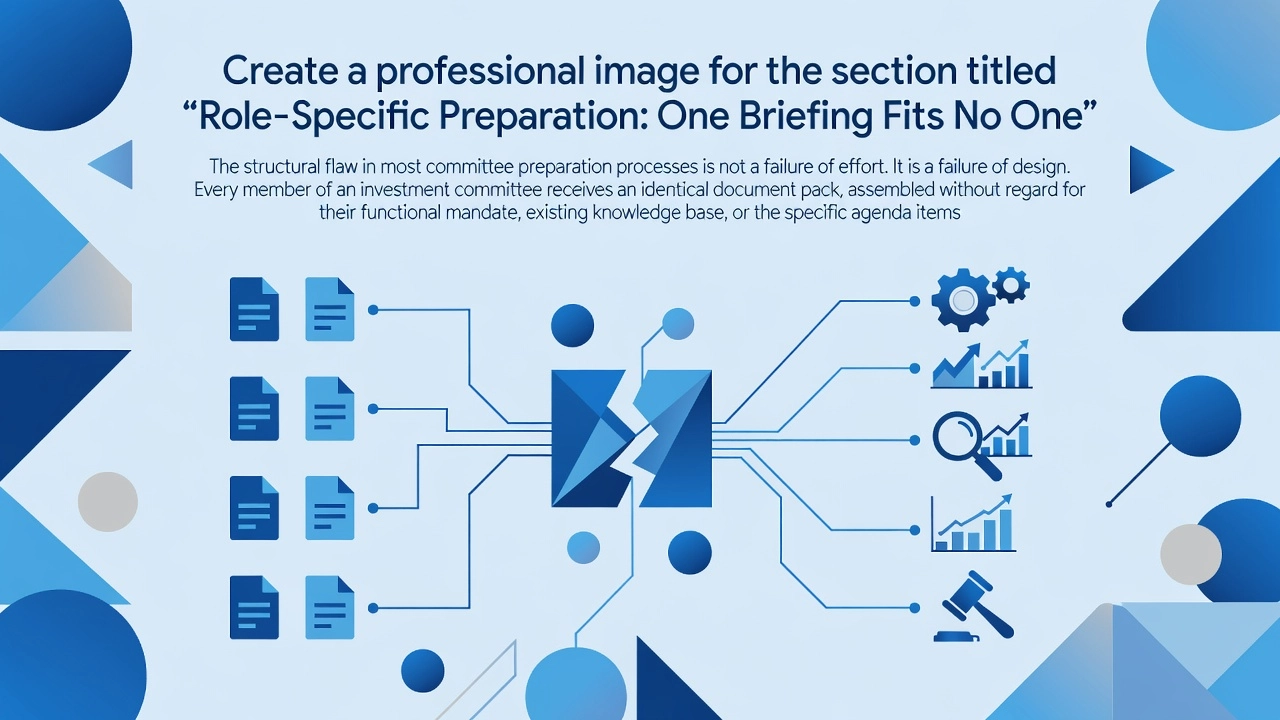
The structural flaw in most committee preparation processes is not a failure of effort. It is a failure of design. Every member of an investment committee receives an identical document pack, assembled without regard for their functional mandate, existing knowledge base, or the specific agenda items where their contribution is most critical. The result is a preparation process that simultaneously overwhelms members with material outside their remit and under-serves them on the information they actually need to do their job in the room. Over-briefing and under-briefing occur in equal measure, distributed uniformly across people whose value to the committee is defined by the fact that they are not interchangeable.
The Chair's Information Need
The committee chair requires a fundamentally different briefing from every other attendee. Their pre-meeting priority is procedural and decisional coherence: which items require a formal resolution versus an open discussion, what action items from prior sessions remain outstanding, whether quorum conditions are satisfied, and how the agenda sequences against the time available. The chair is accountable for governance integrity across the session, not for executing the technical analysis that individual members bring to the table. Routing granular portfolio exposure analytics or deal-level financial modelling through the chair's preparation pack does not serve their function. It consumes preparation time that should be spent on the decisions requiring formal resolution and the governance context holding the session together.
The Risk Officer's Signal-to-Noise Problem
A risk officer arriving at an investment committee meeting needs current exposure data, sensitivity analyses, concentration metrics, and the specific risk flags surfacing from the latest reports. What they do not need, as a primary preparation input, is the deal origination narrative and investment thesis documentation that primarily serves the portfolio management function. When both are bundled into the same pack, the risk officer must excavate the relevant signal from a document structured around a different analytical purpose. Their pre-meeting preparation is not merely inefficient; the framing of the material actively shapes how risk is perceived before deliberation even begins.
The External Advisor's Structural Disadvantage
Independent and external advisors carry none of the institutional memory that internal members accumulate across sessions. They have not attended prior meetings, do not have standing access to internal systems, and cannot fill contextual gaps through informal conversation before the session starts. Their preparation requirement is, in structural terms, the inverse of an experienced internal member: they need more contextual foundation per agenda item to contribute meaningfully, not less. A well-constructed, deal-specific briefing that supplies the background an internal member already holds is more valuable to an independent advisor than the full internal pack. Their tolerance for time lost to institutional catch-up is also the lowest of any committee member, precisely because their independence and external perspective is what justifies their presence. Forcing them to reconstruct context that should have been curated for them undermines the quality being purchased.
Personalisation as Structural Requirement
The conclusion that follows from each of these profiles is not that personalised briefing is a useful enhancement to a functioning process. It is that generic briefing is structurally inconsistent with the design logic of the committee itself. Committees are composed of members with different mandates because those differences improve collective judgment. A preparation process that treats all members as informationally identical contradicts that logic at the point where it matters most. This is the problem that Quorum addresses directly: by transforming existing committee documents into personalised, role-calibrated audio briefings for each attendee, the preparation stage is rebuilt around the actual structure of the committee, rather than the administrative convenience of a single document pack.
The Regulatory Case for Structured Pre-Meeting Preparation
Pre-meeting preparation is not merely a performance habit for well-run investment committees. Under the regulatory frameworks governing institutional investment activity across Switzerland and the European Union, it functions as a demonstrable compliance asset, one whose quality, consistency, and auditability carry material weight during supervisory review.
FINMA and the Traceability Requirement
Under Switzerland's Financial Institutions Act (FinIA) and the Collective Investment Schemes Act (CISA), FINMA expects supervised entities to operate within defined governance frameworks that produce traceable, contemporaneous documentation of how investment decisions were reached. This expectation extends beyond recording the outcome of a committee vote. Regulators are increasingly focused on the information basis that preceded each decision: what did committee members know, when did they know it, and was that information appropriate to the decision being made? A committee that can demonstrate structured, role-specific pre-meeting briefings creates a materially stronger audit trail than one that simply logged attendance and circulated a document pack. FINMA Circular 2017/1 on Corporate Governance establishes the foundational expectation that decision-making processes be both documented and defensible under supervisory scrutiny, treating information governance as an organisational requirement rather than an administrative courtesy.
MiFID II: Adequate Information as an Organisational Obligation
For investment firms operating under MiFID II (Directive 2014/65/EU), the requirement to demonstrate adequacy of the information basis for investment decisions is codified at the organisational level. Article 16 imposes obligations on firms to establish and maintain robust internal governance arrangements, with record-keeping sufficient to enable regulatory review of how decisions were made. ESMA's technical guidance reinforces that governance records must reflect not simply that information was made available, but that decision-making processes were substantively followed. In practice, this places the burden on investment committees to demonstrate that members were meaningfully informed before deliberation began, not merely that a set of materials was uploaded to a shared folder in advance.
AIFMD: Consistency, Documentation, and Defensibility
The Alternative Investment Fund Managers Directive (2011/61/EU), along with Commission Delegated Regulation (EU) No 231/2013, requires AIFMs to maintain documented, consistent investment processes that are defensible under National Competent Authority review. Articles 18 and 20 address organisational requirements and due diligence obligations in terms that directly implicate how investment committee processes are structured and recorded. The critical regulatory question is not only whether a process exists, but whether it was applied consistently across meetings and whether the distribution and consumption of pre-meeting information can be demonstrated. AIFMD II, which entered into force in 2024, has further reinforced expectations around operational governance, making process consistency an active supervisory focus rather than a background assumption.
SFDR: ESG Review as Mandatory Pre-Meeting Content
The Sustainable Finance Disclosure Regulation (EU) 2019/2088, with its Level 2 Regulatory Technical Standards applying from January 2023, has added a regulatory dimension to pre-meeting reading that committees cannot treat as optional context. In-scope firms are required to review and document ESG-related information, including principal adverse impact indicators, as part of their investment decision processes. This obligation is entity-level and product-level simultaneously, meaning that committee members are now expected to have engaged with sustainability risk data before decisions are made, not as a post-hoc reporting exercise. The practical effect is a meaningful expansion of the pre-meeting reading burden, layered directly on top of the financial and risk materials that committees already manage.
Taken together, these regulatory frameworks converge on a single operational conclusion. A structured, consistent pre-meeting briefing process, one that delivers role-appropriate information to each committee member within a documented and repeatable framework, creates an auditable record of information governance that document distribution alone cannot replicate. Sharing a PDF establishes delivery. A structured briefing process establishes preparation. For FINMA-supervised entities and EU-regulated investment firms alike, the difference between those two positions is precisely the difference regulators are trained to probe.
Why Existing Tools Do Not Solve This Problem
The institutional technology market offers two well-developed categories of tooling for investment committees, and both fall structurally short of solving the preparation problem. Understanding precisely where each category stops is essential to understanding why the gap exists and why it persists.
The Document Governance Category: Distribution Without Comprehension
Board portal and committee management platforms represent the most established category of purpose-built investment committee technology. These platforms solve a genuine and important set of problems: secure document delivery to authenticated members, version control, e-signature workflows, voting mechanisms, and auditable trails that satisfy governance and regulatory requirements. For compliance officers and committee secretaries, they are indispensable. What they do not do is synthesise, contextualise, or personalise the materials they deliver. A 280-page board pack distributed through a secure portal is still a 280-page board pack. The platform has ensured it arrived; it has done nothing to help the recipient extract what is relevant to their specific role, their existing knowledge level, or the particular decision on the agenda. The preparation burden remains entirely with the reader, unchanged by the sophistication of the delivery mechanism.
The AI Meeting Tool Category: Solving the Wrong Half of the Problem
The second major category, generic AI meeting tools, addresses a different temporal moment entirely. Transcription engines, post-meeting summary generators, and action item extraction tools are built around what happens after the meeting concludes. They capture, they summarise, they assign. These are genuinely useful capabilities for operational follow-through. However, they are architecturally oriented toward the past, not the future. They process what was said; they do not prepare members for what needs to be decided. Beyond the timing problem, none of these tools are designed with investment committee workflows in mind. Financial services compliance requirements, including structured records management, fiduciary documentation standards, and the audit-trail expectations embedded in frameworks like MiFID II and AIFMD, are absent from their product logic entirely.
The Unoccupied Space Between Two Categories
The gap these two categories leave is precise and consequential. It is the pre-meeting window: the period after document packs have been distributed and before the session begins, during which committee members need synthesised, role-specific, digestible briefings rather than raw materials. Knowledge management platforms and financial data terminals could theoretically surface relevant content, but none deliver proactive, role-aware, audio-format briefings calibrated to a member's function or the committee's cadence. The combination of pre-meeting timing, role-specific personalisation, audio format, and investment committee workflow context is, structurally, unoccupied in the current institutional technology landscape. This is not a feature gap within an existing category. It is an absent category.
How Quorum Transforms Investment Committee Preparation
Quorum addresses the investment committee preparation problem at its structural root. The platform works by automatically ingesting existing company documents, including investment memos, portfolio risk reports, mandate compliance summaries, and meeting packs, and transforming that material into concise personalised audio briefings calibrated to each committee member's specific role and contextual knowledge. The chair receives a briefing weighted toward governance sequencing and agenda priorities. The risk officer receives one focused on exposure data and sensitivity thresholds. The external advisor receives deal-specific background without redundant organisational context they already hold. No manual curation is required. The transformation happens directly from documents the organisation already produces, meaning there is no additional authoring burden placed on investment teams.
Audio as the Right Format for the Right Professional
The format itself is not incidental. Senior investment professionals and C-suite executives have structurally limited reading time, but they consistently have audio time: during commutes, between client calls, during transitions between engagements. Podcast-format content consumption among senior professionals has grown steadily since 2020, driven precisely by this time compression dynamic. A short, concise audio briefing consumed during a morning commute requires no screen, no desk, and no blocked calendar time. It slots into the negative space of an already-overloaded schedule. For committee members who have historically skimmed documents or arrived reliant on the chair's verbal recap, the audio briefing format removes the preparation barrier entirely by meeting professionals where their attention already is.
Serving the Unscheduled Emergency Session
The capability becomes most consequential when time is shortest. When a mandate breach surfaces mid-week, or an erroneous trade requires immediate governance review, committees must convene without the luxury of standard preparation cycles. Quorum can generate role-specific audio briefings from existing documentation within the narrow window between incident identification and session convening. Every member arrives with the same contextual baseline, even under acute operational pressure. This directly addresses the risk identified in earlier sections: that emergency sessions are disproportionately vulnerable to information asymmetry and rushed, low-quality decisions precisely when the quality of those decisions matters most.
Async Delivery for Distributed Committees
For hybrid and globally distributed committees, where synchronous pre-meeting calls across time zones create their own friction and scheduling cost, audio briefings can be delivered and consumed asynchronously. A committee member in Zurich and one in Singapore each receive their tailored briefing and consume it independently at a convenient point before the session. No alignment call is required. No one waits for the slowest time zone to find availability.
A Documented Preparation Record for Regulators
Quorum's structured briefing process also generates a consistent, documented record of information distribution across committee members, addressing the auditability expectations embedded in FINMA governance frameworks, MiFID II's decision-documentation requirements, and AIFMD's investor protection standards. Each briefing cycle creates a traceable log of what each member received, when they received it, and in what form. For compliance officers managing regulatory scrutiny of investment decision governance, this structured preparation record provides precisely the evidence trail that informal, ad hoc preparation processes cannot.
Decision Quality Is the Metric That Matters
The central argument of this article is not that investment committees should run shorter meetings. It is that they should make better decisions. Time savings are a consequence of structured preparation, not the objective. The genuine business case rests on something with far greater fiduciary weight: whether the governance body responsible for managing institutional capital is functioning at the level its mandate requires.
Every element of unpreparedness compounds. The 240-hour annual figure established earlier is a floor calculated on direct in-meeting catch-up time alone. It excludes the cost of decisions that require reversal after new information surfaces post-meeting, the regulatory exposure generated by incomplete governance records, and the disproportionate senior time consumed when an investment breach or erroneous trade forces an emergency session with no preparation infrastructure in place. When those downstream costs are incorporated, the true cost of the preparation gap is materially larger than any single calculation captures.
Preparation quality connects directly to portfolio outcomes through a mechanism that is well-established in governance research: committees that begin deliberation from a shared, accurate contextual baseline exercise genuinely independent judgment. They do not defer to the best-briefed participant. They do not compress deliberation to accommodate background briefings. They produce records that reflect structured, traceable reasoning rather than reactive consensus, and those records are precisely what regulators under MiFID II, AIFMD, and FINMA frameworks expect to find.
Investment committee members and governance professionals reading this article should conduct an honest audit of their current preparation process. The criteria are clear: does every member arrive with role-specific context, not a generic document pack? Does your process hold when a breach notification arrives at short notice? Does your tooling close the gap between document distribution and genuine member readiness, or does it simply confirm that materials were sent?
Quorum is built specifically for that gap. If your current process cannot answer those questions with confidence, the cost of that gap is already accruing.