How to Prepare for a Meeting in 5 Minutes (Without Skipping What Matters)
The calendar notification just popped up: your meeting starts in five minutes. Sound familiar? Whether it's a last-minute client call or a team check-in that snuck up on you, most professionals have been there, scrambling to look prepared when they barely have time to refill their coffee.
The good news is that knowing how to prepare for a meeting quickly is a skill you can actually master. It does not require an hour of review or a perfectly color-coded agenda. What it does require is a clear, repeatable process that cuts straight to what matters and leaves the rest behind.
In this guide, you will learn a focused five-minute framework that helps you walk into any meeting with confidence. We will cover what to review, what questions to ask yourself beforehand, and how to show up ready to contribute, not just observe. Whether you are preparing for a routine sync or a high-stakes presentation, these steps will help you make every minute count, before the meeting even begins.
Why Quick Meeting Prep Fails Most People
The standard advice has not changed in decades. Review the agenda, read the pre-read, skim the deck. This guidance was built for a world where professionals attended a handful of meetings per week and documents rarely exceeded a few pages. That world no longer exists for most knowledge workers.
According to Atlassian's research on workplace productivity, unnecessary meetings cost employees significant hours every week, with a large proportion of meeting time considered unproductive. Doodle's State of Meetings research has similarly documented how meeting frequency has increased substantially, leaving professionals with less time between obligations to prepare meaningfully. When meeting volume is high and documents are long, the standard prep checklist becomes functionally impossible.
The core mechanism behind failed preparation is cognitive overload. When an attendee faces a 40-page pre-read document alongside three other pressing deadlines, the brain does not respond by partially completing the task. It skips the task entirely. This all-or-nothing response is a well-documented feature of how people manage competing cognitive demands, not a personal failing or lack of discipline.
Generic preparation advice compounds the problem by treating every attendee as identical. A decision-maker needs to understand the recommendation and its tradeoffs. A contributor needs to know precisely what input is expected. An observer needs only the outcome and relevant context. Most prep guidance ignores this distinction entirely, offering one-size-fits-all checklists that serve none of these roles particularly well.
The most important reframe is this: the goal of preparation is not to have read everything. It is to arrive with a clear point of view. Preparation should be understood as cognitive readiness, not content consumption. When that distinction is made, the question shifts from "how much can I get through?" to "what do I need to know in order to contribute?"
The 5-Minute Meeting Prep Framework
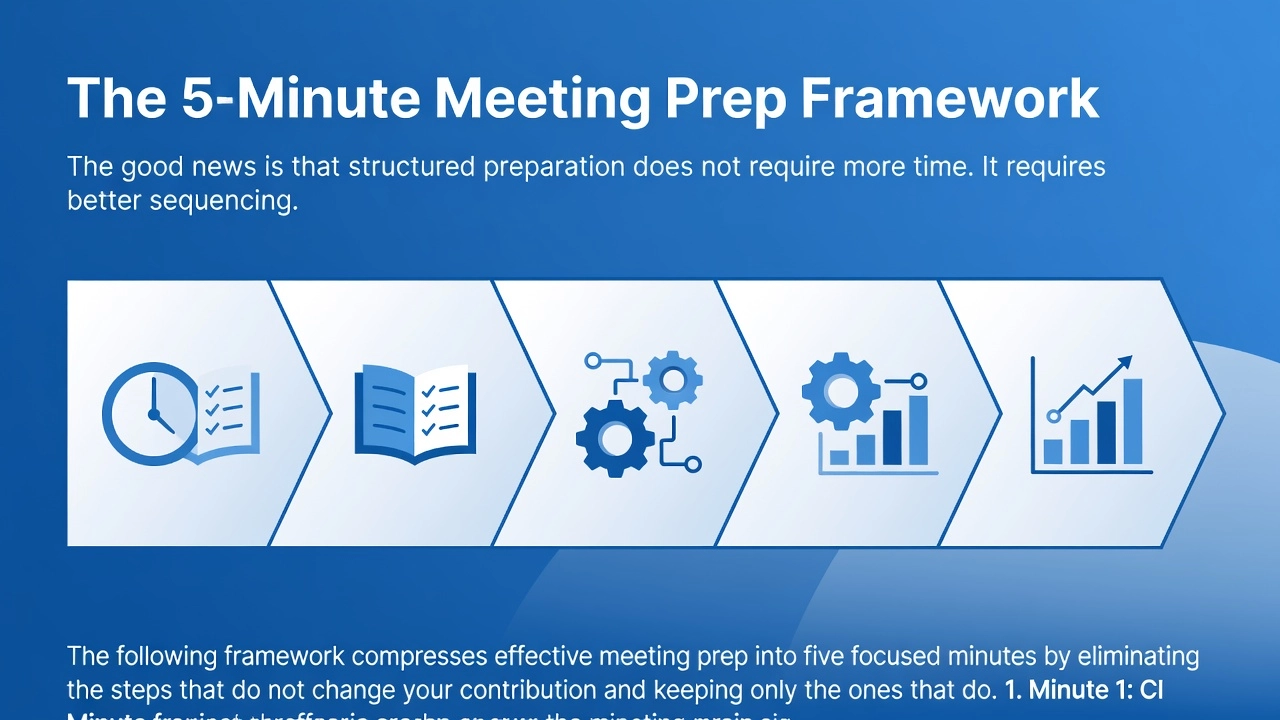
The good news is that structured preparation does not require more time. It requires better sequencing. The following framework compresses effective meeting prep into five focused minutes by eliminating the steps that do not change your contribution and keeping only the ones that do.
1. Minute 1: Clarify Your Role
Before you open a single document, identify whether you are a decision-maker, a contributor, or an observer in this specific meeting. These three roles are not interchangeable, and they demand meaningfully different preparation depth.
A decision-maker needs to arrive ready to choose between options and own the outcome. A contributor needs to arrive ready to inform that choice with data, context, or a clear recommendation. An observer needs enough context to follow the discussion without derailing it with catch-up questions. Getting this wrong is costly: according to this strategic decision framework for effective board meetings, a common failure mode is "asking for advice when you actually need approval," and that ambiguity creates rework and slowdowns that extend well beyond the meeting itself.
Spend sixty seconds confirming your role. Check the meeting invite, the agenda owner, or the attendee list if necessary. Everything that follows in the next four minutes depends on this answer.
2. Minute 2: Read the Agenda Critically
Most people scan an agenda for topics. The more useful question is: what single decision or outcome must this meeting produce? Every item on an agenda exists to serve that output. When you identify it, you immediately know which discussion thread deserves your full attention and which ones are context-setting.
If no agenda exists, do not simply join and wait to see what happens. Send one direct message to the organiser before you join: "What's the key decision or outcome we need to reach today?" That question is not intrusive; it signals preparation and often prompts the organiser to clarify the meeting's purpose for everyone. As this board meeting preparation guide notes, an agenda without stated expected outcomes is a governance red flag, not just an inconvenience, and the same principle applies to any professional meeting.
3. Minute 3: Locate and Scan the One Most Relevant Document
You do not have time to read everything, and reading everything is not what makes you a better contributor. What matters is reading the right section of the right document.
Based on the role you identified in minute one, find the single document most directly relevant to your position: the decision memo, the financial summary, the one-page brief. Then scan only the sections that inform what you will say or decide. High-performing teams, including those following the three essential preparation strategies outlined here, use pre-reads specifically to ensure live meeting time is spent on decisions rather than on transferring information that could have been absorbed beforehand. Apply that same logic to your individual preparation: scan for deltas, risks, and recommendations rather than re-reading everything from the beginning.
4. Minutes 4 to 5: Define Your Position
This is the step most professionals skip, and it is the one that separates active contributors from passive attendees. Before you join, write one sentence that completes this prompt: "In this meeting, I will recommend, support, or ask..."
Your position does not need to be complex. "I will recommend we delay the launch by two weeks based on the retention data" is sufficient. "I will ask whether the budget figure includes the implementation cost" is equally valid. The act of writing it forces clarity that thinking alone rarely produces. It also means you arrive with an anchor, a starting position that can be refined during discussion rather than assembled from scratch under pressure.
This single sentence is your most important preparation output. Everything in the previous four minutes exists to make it possible to write it accurately and confidently.
How Your Role in the Meeting Changes What You Should Prepare
Not all meeting attendees are the same, yet almost every preparation guide treats them as if they are. Research into meeting roles confirms that effective meetings depend on participants understanding what is expected of them, but stops short of telling each attendee type how to prepare differently. That gap is where most preparation time gets wasted.
Decision-Makers
If you are attending a meeting to make a call, your preparation has one job: give you enough context to evaluate options and apply sound criteria. You do not need to read every supporting document or trace every data point back to its source. You need to know what the options are, what the key tradeoffs look like, and what a good outcome actually requires. Over-loading a decision-maker with background material before a meeting often produces slower, less confident decisions, not better ones. Prepare narrowly and purposefully.
Contributors
If you are attending to provide input, your preparation should focus on two things: what the group is specifically expecting from you, and what constraints or dependencies exist that might affect your contribution. A subject-matter expert who arrives without understanding the budget ceiling, the timeline, or the decision already made upstream will produce input the group cannot use. Knowing the boundaries of the problem is as important as knowing the subject.
Observers
If you are attending to stay informed or flag downstream impacts, you need only enough context to follow the conversation and identify anything that affects your work. Over-preparing as an observer is one of the most common and least discussed time drains in meeting culture. Spending thirty minutes reading documents for a meeting where your role is purely passive is a preparation mismatch, not thoroughness.
The step most preparation guides skip entirely is asking a simple diagnostic question before anything else: am I here to decide, contribute, or observe? Spending five minutes on the wrong information consistently produces worse outcomes than spending one focused minute on the right information.
This is the core argument for personalized preparation. The most effective briefings are not one-size-fits-all summaries pushed to every attendee. They are role-specific, context-aware inputs built around what each person actually needs to do in the room. Generic agendas and shared pre-reads treat everyone as the same participant. Truly efficient preparation treats each attendee as someone with a distinct job to do before the meeting even begins.
The Preparation Problem That Better Time Management Cannot Fix
The challenge most professionals face with meeting preparation is not a time management failure. It is a structural mismatch between how organizations deliver pre-meeting information and the fragmented reality of modern work.
Meeting volume has grown dramatically, rising 252% since February 2020, while the conditions required for quality preparation have deteriorated at the same pace. The average knowledge worker now attends roughly 21 meetings per week, which means 21 separate preparation events competing for the same shrinking pool of available attention. No personal productivity system resolves an arithmetic problem of that scale.
Hybrid and remote work has compounded this by eliminating the consistent desk-bound blocks that text-heavy pre-reads were originally designed for. With 98% of meetings now including at least one remote participant, attendees are preparing across wildly different contexts: on phones between calls, during commutes, in shared spaces, or in the five minutes before a session starts. The organizational response to this shift, sending the same PDF or slide deck regardless of context, has not changed to reflect that reality.
This is where the format question becomes critical. Reading a document requires a desk, a screen, sustained attention, and quiet. Research on information processing under divided attention consistently shows that audio-format content performs better in fragmented environments precisely because it does not require the listener to resolve all those conditions simultaneously. A spoken briefing can be absorbed during a commute or a walk between meetings; a twelve-page briefing document cannot.
The deeper problem is that most organizations have never questioned whether reading is the right default format for pre-meeting preparation. The assumption has simply persisted. When preparation is reframed not as "reading the documents" but as "arriving ready to contribute," the format used to get there becomes the variable worth examining, not the effort of the person trying to prepare.
Why Audio Is the Fastest Path to Meeting Readiness
The structural mismatch identified in the previous section points toward a clear solution: shift the medium, not just the timing. Audio preparation solves the core problem that text-based prep cannot, because it decouples information consumption from a desk and a screen.
Professionals already spend significant portions of their day in contexts where listening is natural but reading is either impractical or cognitively costly. A commute, a walk between offices, or the five minutes transitioning from one task to the next are all moments where audio works seamlessly and a PDF does not. Trying to absorb a dense pre-read document during these windows creates divided attention and reduced retention. Audio, by contrast, fits the context without competing with it.
This shift aligns with a measurable change in how knowledge workers prefer to consume information. Podcast and on-demand audio consumption among professionals has grown consistently through 2024 and into 2026, with work-related audio content representing one of the fastest-growing format categories. The preference is not incidental; it reflects a genuine cognitive fit between audio delivery and mobile, fragmented schedules.
The efficiency gain is also direct. Where most preparation guidance recommends 15 to 30 minutes of document review, a personalized five-minute audio briefing covering the agenda context, relevant documents, and role-specific priorities compresses that window without sacrificing comprehension.
This is precisely the use case Quorum is built for. Quorum automatically transforms existing company documents into a personalized podcast briefing of five minutes (on average) tailored to each individual attendee, so every participant arrives informed without opening a single file. In hybrid environments where async, mobile-compatible preparation has become standard rather than optional, that capability is not a convenience feature. It is a structural fix to the preparation gap that scheduling and willpower alone cannot close.
What Arriving 'Ready to Decide' Actually Looks Like
Consider two professionals walking into the same quarterly business review. The first spent forty minutes the night before reading every page of the pre-read document. They can summarize the financials and recall several supporting charts. But when the conversation turns to a critical resource allocation decision, they have no clear position. They wait to see which way the room moves.
The second attendee spent five minutes. They identified their role as a decision contributor, confirmed that the meeting's central question was whether to reallocate budget from one product line to another, and formed a clear recommendation based on the numbers most relevant to their function. When they speak, they advance the discussion. The first attendee consumed more. The second contributed more.
This distinction reframes what preparation quality actually means. Being ready to decide requires three things: knowing what outcome the meeting needs to produce, holding a clear position on the key question before the room convenes, and knowing what you will ask if the conversation drifts off course. Document coverage does not appear anywhere in that definition.
The mindset shift here is significant. Preparation is not a passive, consumption-based activity; it is an output-oriented one. The most effective meeting cultures treat this as standard practice rather than an individual habit. When teams arrive consistently ready to decide, the organizational returns compound: meetings run shorter, fewer follow-up sessions are needed to revisit decisions that stalled, and execution accelerates because alignment is reached in the room rather than chased afterward.
Start Preparing Smarter, Not Longer
The five-minute framework covered throughout this guide comes down to four repeatable steps: clarify your role, identify the key decision at stake, find the one document most relevant to your position, and define your point of view before entering the room. That sequence is the complete preparation system. It works not because it is comprehensive, but because it is precise.
The central reframe is worth restating plainly. Preparation is not information consumption. It is position formation. Arriving with a clear, role-specific perspective moves meetings forward far more effectively than arriving with a full reading list completed and no conclusions drawn.
The structural reality makes this reframe urgent rather than optional. Meeting volume has increased 252% since 2020, and the average knowledge worker now attends nearly 22 meetings per week. As document volume scales alongside meeting frequency, manual text-based preparation will become unsustainable for most professionals at any level.
The best-run teams are responding by moving toward automated, personalized briefings that do the synthesis work for each attendee before the meeting begins. Quorum makes this possible by turning your existing company documents into a short, personalized podcast tailored to each participant's role and context. If your team is ready to close the preparation gap for good, explore what Quorum can do for your meetings.